
Table of contents
- Purpose of the Feasibility Study
- Feasibility Study process flow
- Generic rules for the feasibility study process
- Phases of the Feasibility Study
- Phase Harmonization Conference
- Phase Feasibility Study Elaboration
- Phase Feasibility Study Elaboration
- Phase Feasibility Study Result
1. Purpose of the Feasibility Study
The feasibility study process allows the applicant to get support from the IMs for planning a train service before placing a path request.
2. Feasibility Study process flow
Introducing the feasibility study process flow:
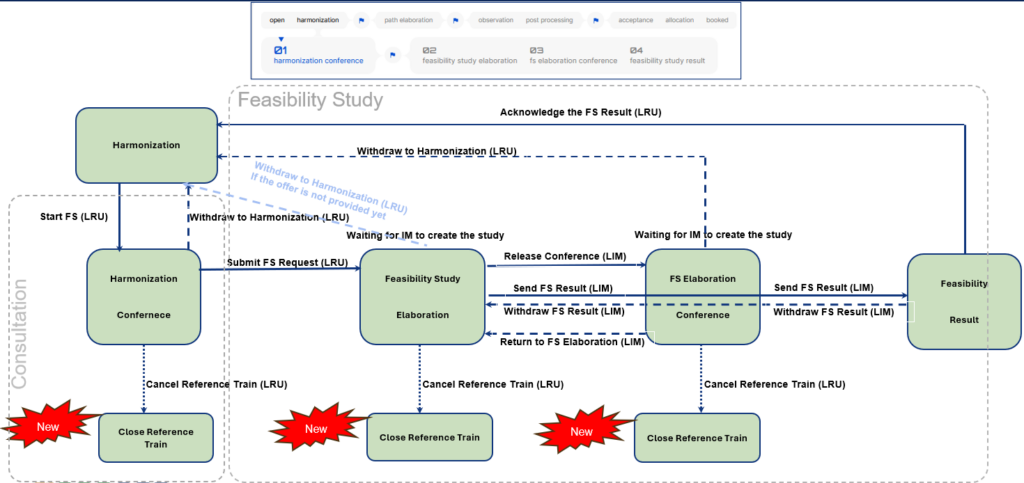
3. Generic rules for the feasibility study process
In the new version of PCS Capacity Broker, the following rules apply:
- Applicants are working on their requests on the Requests tab (same as in the PCS EC Applicant timetable)
- IMs/ABs are working on their studies on the Studies tab (same as in the PCS EC IM timetable).
- The progress status (lights) resets in each phase of the feasibility Study
- The button to submit to the next phase will appear only if the criteria are met to submit
- No partial harmonization is possible in the process
- There is no automatic copy of the timetables during the process, so in the feasibility elaboration phase, the offer should be manually drafted by the IMs
4. Phases of the Feasibility Study
- Harmonization Conference
- Feasibility Study Elaboration
- Feasibility Study Elaboration Conference
- Feasibility Study Result
Read each phase below in detail.
5. Phase Harmonization Conference

5.1 Description
- This is the first phase of the feasibility study process and serves for feasibility study preparation
- The requests are visible to all the involved companies, and all the participants should know the reference train content before joining the timetable-related meetings and conferences
- If the reference train should run through the feasibility study, all the required data should be consulted, recorded and harmonized
- If any Applicant disagrees, its light should be on red to avoid the feasibility study request
- Freight traffic users cannot add PaPs to their reference trains, they have to return to the Harmonization to add them
5.2 Possible transitions
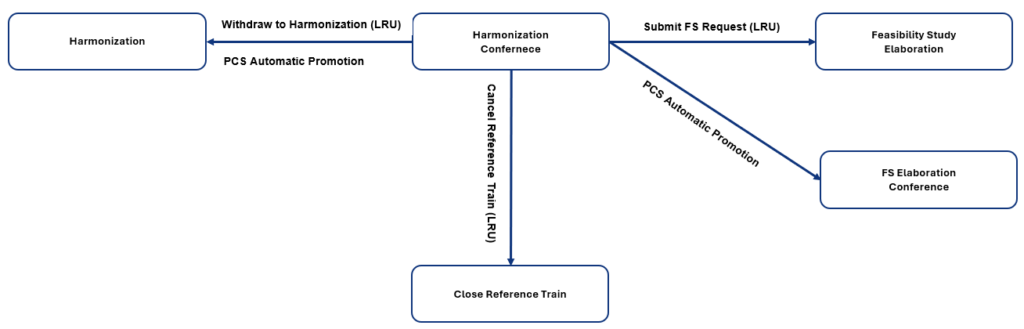
5.3 Transition list
A change from one phase to another, manually or automatically, moving further in the process with the possible conditions.
- Harmonization Conference -> Feasibility Study Elaboration
- Who:
- Leading Applicant
- Restrictions:
- All Applicant lights are green or yellow
- Only if the calendar is harmonised
- Mandatory common train parameters are fulfilled, and there is no missing data
- Restrictions:
- Leading Applicant
- Who:
- Harmonization Conference -> Harmonization
- Who:
- Leading Applicant
- Restrictions
- None
- Restrictions
- Leading IM
- Restrictions
- None
- Restrictions
- PCS system (Automatic promotion, Deadline promotion -“Promotion_2”)
- Restrictions
- None
- Applied the day after the Harmonization Conference phase deadline
- Restrictions
- PCS system (Automatic promotion, Deadline promotion -“Promotion_2”)
- Restrictions
- None
- Applied the day after the New Path request deadline
- Restrictions
- PCS system (Automatic promotion, Time limit promotion -“Promotion_2”)
- Restrictions
- Applied 8 days since the last save operation of the reference train
- Applied if the reference train hasn’t touched or edited for 15 days
- If one Applicant light is red or blue
- It is switched off for about a week in January (Please search for “PCS process guidelines (year)” for the exact details)
- Restrictions
- Leading Applicant
- Who:
- Harmonization Conference -> Feasibility Study Elaboration Conference
- Who:
- Leading Applicant
- Restrictions
- All Applicant lights are green or yellow
- Mandatory common train parameters are fulfilled, and there is no missing data
- Restrictions
- PCS system (Automatic promotion, Deadline promotion, Promotion_1)
- Restrictions
- All Applicant lights are green or yellow
- Mandatory common train parameters are fulfilled, and there is no missing data
- Restrictions
- Leading Applicant
- Who:
- Harmonisation conference -> Closed
- Who:
- Leading Applicant
- Restrictions
- None
- Restrictions
- Leading Applicant
- Who:
5.4. Access rights
The list of access rights available to roles in PCS.
- Leading Applicant
- Read and write access to their own section
- Responsible Applicants
- Read and write access to their own sections
- Leading IM
- Read access when joining the process for the 1st time
- Write access to their own section when joining the process multiple times
- Responsible IMs
- Read access when joining the process for the 1st time
- Write access to their own section when joining the process multiple times
- C-OSS
- Read access to requests
5.5 Other informations
- Applicants/IMs can copy/update the study paths from the feasibility study result when joining the process multiple times
- If the reference train is cancelled by the Leading Appicant the reason for the action must be provided
- If the New Path Request deadline has passed and the reference train is still in the Harmonization Conference phase, then the process type is converted from New Path Request to Late Path Request (Process conversion, Promotion_36)
- If the Late Path Request deadline has passed and the reference train is still in the Harmonization Conference phase, then the process type is converted from Late Path Request to Adhoch Request (Process conversion, Promotion_42)
6. Phase Feasibility Study Elaboration
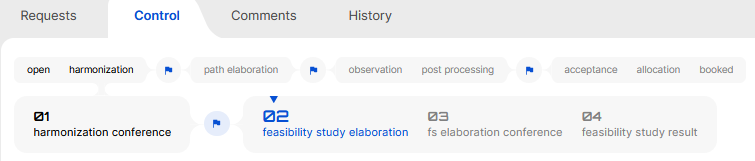
6.1 Description
- The leading IM prepares the study and then decides whether to consult with the applicants or send them the drafted offer as the feasibility study result
- The RIM can set the status to not accepted, to reject giving an offer to a request
- If there was an offer/s, but the IMs deleted it, the acceptance indicators are set back to blue
- Accepted status can only be set if there are no validation errors on the territory
- The study paths must be harmonized, partial offer is not possible
6.2 Possible transitions
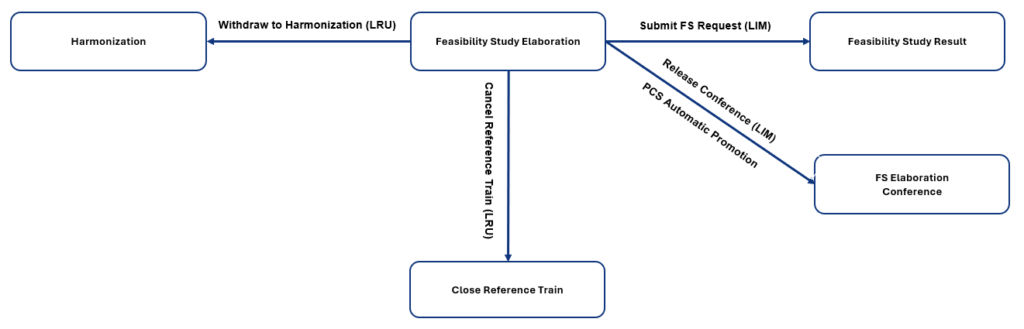
6.3 Transition list
A change from one phase to another, manually or automatically, moving further in the process with the possible conditions.
- Feasibility Study Elaboration -> Harmonization
- Who:
- Leading Applicant
- Restrictions
- None
- Restrictions
- Leading Applicant
- Who:
- Feasibility Study Elaboration -> Feasibility Study Result
- Who:
- Leading IM
- Restrictions
- None
- Restrictions
- Leading IM
- Who:
- Feasibility Study Elaboration -> Feasibility Elaboration Conference
- Who:
- Leading IM
- Restrictions
- None
- Restrictions
- PCS system (Automatic promotion, Time limit promotion, Promotion_33)
- Restrictions
- Applied 8 days since the last save operation of the reference train
- If one IM light is red or blue
- Restrictions
- Leading IM
- Who:
- Feasibility Study Elaboration – > Closed
- Who
- Leading Applicant
- Restrictions
- None
- Restrictions
- Leading Applicant
- Who
6.4 Access rights
The list of access rights available to roles in PCS.
- Leading Applicant
- Withdraw only if the offers were not provided; the button is only visible to them without offers
- No access to studies, not visible to them
- Responsible Applicants
- No access to studies, not visible to them
- Leading IM
- Read and write access to their own sections
- Responsible IMs
- Read and write access to their own sections
- C-OSS
- No access to studies, not visible to them
6.5 Other details
- IMs can add one or multiple studies to a request when clicking the add study path button
- The IMs can update the status of their requests in their territory in bulk or one by one
- All mandatory fields must be filled (journey, parameters, IDs)
- If the New Path Request deadline has passed and the reference train is still in the Feasibility Study Elaboration phase, then the process type is converted from New Path Request to Late Path Request (Process conversion, Promotion_37)
- If the Late Path Request deadline has passed and the reference train is still in the Feasibility Study Elaboration phase, then the process type is converted from Late Path Request to Adhoch Request (Process conversion, Promotion_43)
7. Phase Feasibility Elaboration Conference

7.1 Description
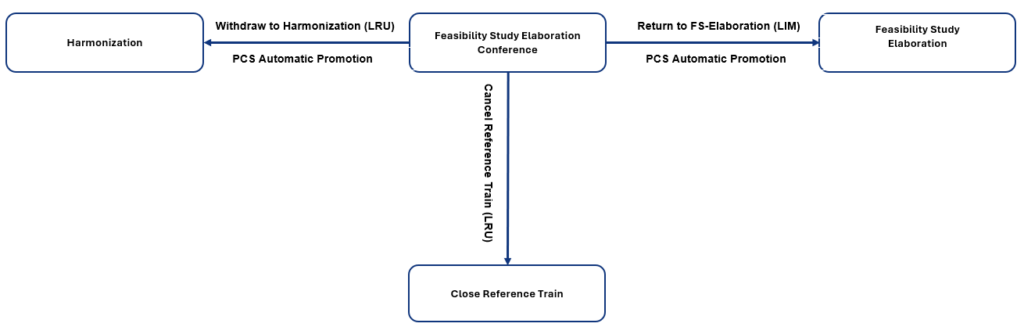
The Feasibility Elaboration Conference phase is designed to allow Applicants and IMs to analyse and work within their respective timetables before sending the dossier back to the Feasibility Study Elaboration.
7.2 Possible transitions
7.3 Transition list
A change from one phase to another, manually or automatically, moving further in the process with the possible conditions.
- Feasibility Elaboration Conference -> Feasibility Study Elaboration
- Who:
- Leading IM
- Restrictions
- None
- Restrictions
- Leading IM
- Who:
- Feasibility Elaboration Conference -> Harmonization
- Who:
- Leading Applicant
- Restrictions
- None
- Restrictions
- PCS system (Automatic promotion, Deadline promotion, Promotion_3)
- Restrictions
- None
- Restrictions
- Leading Applicant
- Who:
- Feasibility Study Elaboration Conference -> Closed
- Who
- Leading Applicants
- Restrictions
- None
- Restrictions
- Leading Applicants
- Who
7.4 Access Rights
The list of access rights available to roles in PCS.
- Leading Applicant
- Read and write access to their own sections
- Responsible Applicants
- Read and write access to their own sections
- Leading IM
- Read and write access to their own sections
- Responsible IMs
- Read and write access to their own sections
- C-OSS
- Read-only access
7.5 Other Informations
- If the New Path Request deadline has passed and the reference train is still in the Feasibility Study Elaboration Conference phase, then the process type is converted from New Path Request to Late Path Request (Process conversion, Promotion_38)
- If the Late Path Request deadline has passed and the reference train is still in the Feasibility Study Elaboration Conference phase, then the process type is converted from Late Path Request to Adhoch Request (Process conversion, Promotion_44)
8. Phase Feasibility Study Result

8.1 Description
- This is the last phase of the Feasibility Study Process. The content of the dossier is visible to all the involved participants.
- The leading Applicant acknowledges the offered harmonized studies and reference train is returned to the main phase, to the Harmonization phase.
8.2 Possible Transitions

8.3 Transition list
- Feasibility Study Result -> Harmonization
- Who
- Leading Applicant
- Restrictions
- None
- Restrictions
- Leading Applicant
- Who
- Feasibility Study Result -> Feasibility Study Elaboration
- Who
- Leading IM
- Restrictions
- None
- Restrictions
- Leading IM
- Who
8.4 Access rights
The list of access rights available to roles in PCS.
- Leading Applicant
- Read-only access
- Responsible Applicants
- Read-only access
- Leading IM
- Read-only access
- Responsible IMs
- Read-only access
- C-OSS
- Read-only access
8.5 Other Informations
- Leading IM has the right to withdraw the Feasibility study response if necessary.
- Exiting the process, the feasibility timetable is created and saved to the studies tab.
- If the New Path Request deadline has passed and the reference train is still in the Feasibility Study Result phase, then the process type is converted from New Path Request to Late Path Request (Process conversion, Promotion_39)
- If the Late Path Request deadline has passed and the reference train is still in the Feasibility Study Result phase, then the process type is converted from Late Path Request to Adhoch Request (Process conversion, Promotion_45)